On the afternoon of October 29, 2025, the College held a special seminar on the construction of smart courses for graduate students. Vice Dean Liu Fang, along with Professors Xia Wei, Yin Changlong, Peng Zhihua, and Specially-Appointed Associate Professor Ren Zhongfei, attended and exchanged ideas. The meeting focused on the in-depth integration of artificial intelligence (AI) with the graduate curriculum system, aiming to promote the innovation of curriculum construction and talent training models through intelligent means.
Vice Dean Liu Fang first introduced the AI-integrated teaching practice of the graduate professional compulsory course "Frontiers of Environmental Science and Engineering" (FESE), demonstrating how to expand teaching boundaries and improve course quality with the help of AI. Professor Xia Wei, in conjunction with Shandong Province’s postgraduate teaching reform project, reported on the exploration and achievements of the international talent training model under the background of the "AI + Chemical Engineering" interdisciplinary discipline. Professor Yin Changlong shared the phased achievements of the professional elective course "Petroleum Chemistry" (PC) in smart course construction, highlighting the advantages of personalized and interactive teaching. Professor Peng Zhihua systematically presented the intelligent teaching practice of "Advanced Organic Chemistry" (AOC) as a professional compulsory course, emphasizing the important role of AI technology in optimizing teaching content and process evaluation.
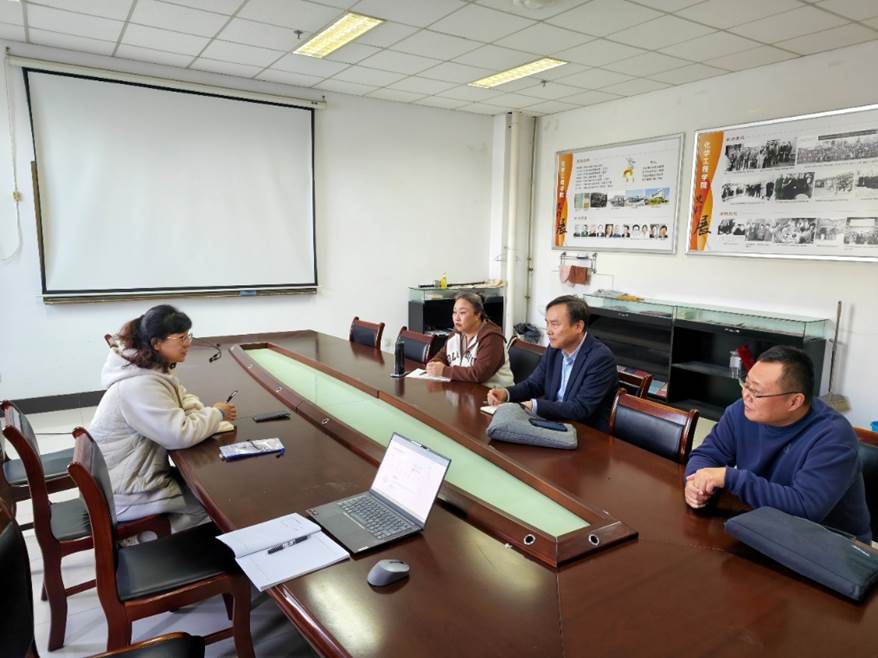
The meeting focused on the development goal of upgrading courses and projects from the university level to the provincial level, and the College is systematically advancing multi-dimensional reforms: at the course level, it is updating core curriculum content, integrating artificial intelligence (AI) technology modules, and planning to compile interdisciplinary AI textbooks; at the platform level, it is building a course knowledge graph and an interactive teaching system by leveraging platforms such as Zhihuishu Platform (SmartTree); in terms of teaching methods, it is enriching the case library through activities such as flipped classroom presentations and scientific paper writing, and exploring the use of channels like official WeChat accounts to expand the influence of smart courses.
In response to current challenges such as uneven student acceptance, insufficient AI-discipline integration, as well as data security and technical reproducibility issues, the college plans to guide students' active participation through "application-oriented learning" and conduct customized AI teaching training for faculty members, and plans to introduce AI-related courses into the graduate training program, systematically advance the development of smart courses and projects, and comprehensively enhance the breadth and depth of AI-enabled graduate education.

 +86 86981731
 66 Changjiang West Road, Huangdao District,Qingdao City, Shandong Province
 weimengji@upc.edu.cn
